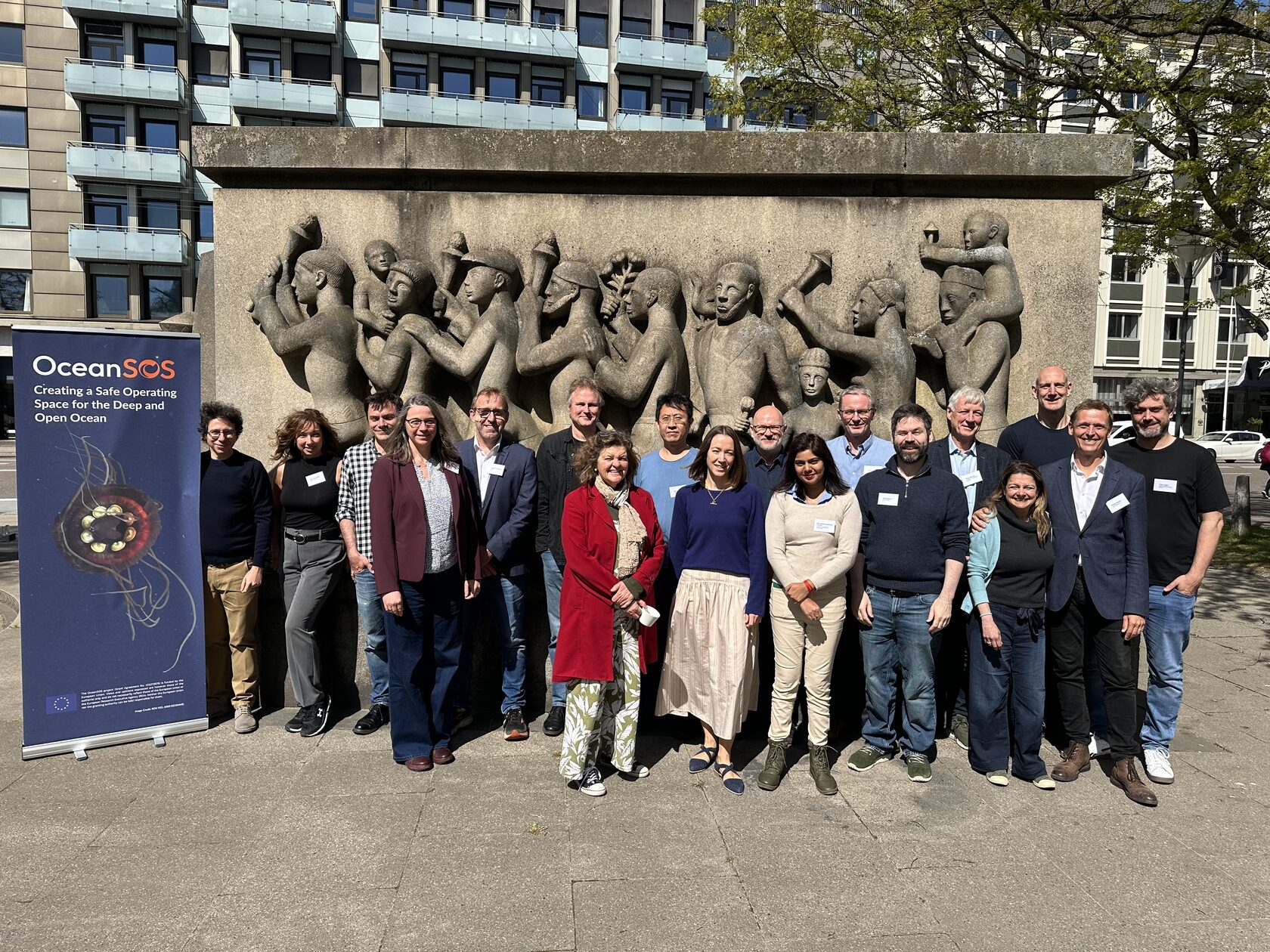
We are thrilled to announce the official launch of OceanSOS (Creating a Safe Operating Space for the Deep and Open Ocean)! Marking the first milestone for this ambitious four-year initiative, our project consortium successfully gathered for its inaugural Kick-Off Meeting from May 18–19, 2026, hosted at the historic venue of Kalaallit Illuutaat (The Greenland House) in Copenhagen, Denmark.
The three-day event brought together the core of our team including oceanographers, ecosystem modellers, environmental lawyers, and socio-economists representing our 14 international partner institutions across Europe, the UK, South Africa, and Canada. Together, partners laid down the operational, scientific, and ethical foundations required run the project.
Setting the Strategic & Scientific Direction
The meeting opened with a warm welcome from our Project Coordinator, Professor Murray Roberts (Mara Consultants), who outlined the challenge OceanSOS is built to confront: the fragmented nature of ocean governance in Areas Beyond National Jurisdiction (ABNJ) and the urgent need to define a regional "Safe Operating Space" (SOS) before human activities and climate pressures cross irreversible ecological tipping points.
The team then dove directly into aligning the project's interdisciplinary workflows:
- Work Package 1 (Threat Intelligence Lifecycle): Led by Heriot-Watt University, partners mapped out the open-source intelligence collection phase, detailing how upcoming expert workshops will profile emerging high-seas risks like mesopelagic fishing and deep-sea mining.
- Work Package 2 (Oceanography & Physics): The Alfred-Wegener-Institut (AWI) presented the computational roadmap for configuring our landmark 5 km eddy-resolving ocean basin models, while teams from Aarhus University and Dalhousie University coordinated the sub-mesoscale models and seamount habitat maps.
- Work Package 3 (Biological Carbon Pump): Imperial College London and SAMS provided an update on the logistical blueprints for deploying deep-sea sediment traps and baited camera landers during upcoming research cruises.
- Work Package 4 (Socio-Economics & Stability): Wageningen University walked the consortium through the design of a multi-country public survey that will establish the ethical "social foundations" and acceptable thresholds for distributing marine risks.
A Strong Focus on Governance, Open Science, and Ethics
A major highlight of the meeting was the active participation of the OSPAR Commission, leading Work Package 5. The OSPAR team outlined a proactive co-design strategy to engage international competent authorities early, building a direct pipeline to propose that our downscaled regional SOS frameworks become formalized criteria under the landmark UN High Seas Treaty (BBNJ Agreement).
To ensure all discoveries are freely accessible to the global community, the data management teams at Work Package 6 from AWI and SAEON established a strict Open Science workflow. All raw data, genetic sequences, and model codes will adhere tightly to the FAIR and TRUST principles, funneling smoothly into major European and global data networks like EDITO, Destination Earth, and ODIS.
Furthermore, reflecting the project’s deep commitment to research integrity, the consortium formally welcomed an independent External Ethics Advisor into our governance structure. This advisor will systematically monitor the ethical handling of human survey participants, animal sample collections, and project footprint limits at sea.
Empowering the Next Generation
The meeting also included a showcase from our education and outreach leads. Plans were solidified for the OceanSOS Fellowship scheme, which will link early-career researchers across networks like AAORIA and Ocean20.
The consortium also celebrated the upcoming launch of our educational curriculum on the SEAmester Floating University cruises off South Africa , alongside a sneak peek into the development of our immersive, global planetarium dome show currently being produced in collaboration with Dynamic Earth.
Looking Ahead
As the banners are packed away and our teams return to their laboratories, offices, and research vessels across the globe, the energy from Copenhagen is clear. OceanSOS is officially underway.
Over the next 48 months, this team will work to deliver the data, tools, and regulatory frameworks required to ensure that the open ocean remains healthy, resilient, and safe for generations to come.